
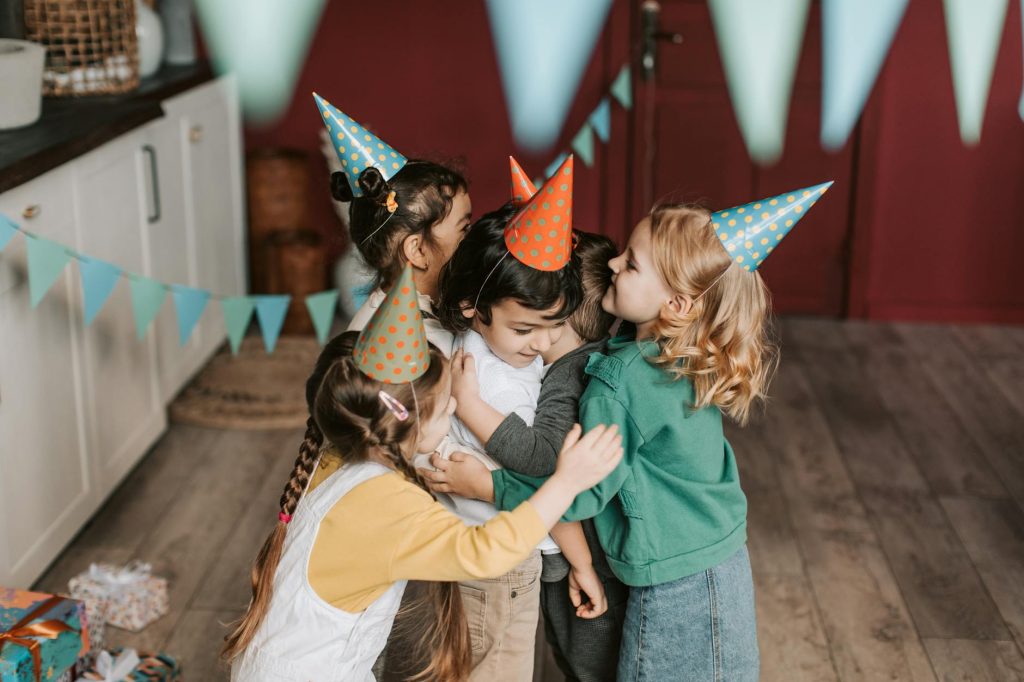
As soon as children start school, they hit the birthday party circuit. Suddenly, they seem to have a party to go to each weekend. Sometimes there’s more than one party. They can even have two parties in a day. It’s a social life that we parents can only envy.
Yet the parties do become rather repetitive. They’re at the same venues, doing the same things – a bouncy castle at the leisure centre, football at the sports club, soft play at the local children’s fun zone.
And then it comes to your child’s party. You want something special, something memorable, something that the kids will really enjoy. You search the internet and rack your brain, trying to come up with that great idea.
But everything seems to have been done before. If it hasn’t, then it’s not suitable for your child’s age group, or it’s too expensive or just impossible to organise.
Yet there is an option that is all too often overlooked – a traditional home party. They can be great fun, and you can make them unique to your child – and that makes them very special.
Of course, a home party has its downsides. There is more for you to do, and undoubtedly, there will be a lot of clearing up afterwards. It also requires you to get more involved, both in planning the party and in organising on the day.
But it will be worth it. You will be giving your child something special, something personal. And it will be something remembered and talked about because many children will have never done anything like it before. They may even begin to eagerly look forward to your child’s next party. What games will we play? I hope we play the balloon game. I wonder if there will be a theme. What will it be?
This article is a guide to putting on a successful home party for children between the ages of five and ten. It is full of advice, suggestions, tips, and information to ensure that the party goes smoothly, is fun and exciting, and that everybody, including you, has a great time.
There are three essential elements for a successful children’s party: planning, preparation and control.
Planning
You cannot have a party without having thought it through in detail. When will it be? How long should it last? What are the children going to do? Who will be coming to the party? How many children will there be altogether? The more you plan the party, the more organised it will be, the better it will go. Poor planning only leads to misery and chaos, disappointment and tears.
And of course, you want it to go well for your child’s sake. It is their party, their friends. They have sent out the invites. It is their popularity and standing as much as yours that is at stake.
Here are some tips to help you plan your child’s party:
Make lists. You’re less likely to forget things. This is particularly necessary for the games. You do not want to have to rush about looking for items whilst the party is in progress. It holds up the party, and it keeps the children waiting, which means they’re not occupied and will end up doing their own thing – that’s when any trouble is most likely to occur (more on this when we look at control).
Write down each game and what you will need for that game. You can then tick off each item as you prepare it. You should also make a list of what you will need to buy. You can then try to get everything in a single shopping trip.
If possible, check beforehand whether any of the children have special dietary requirements – allergies or vegetarianism. If you’re not sure, then make sure you have alternative foods available in case they’re needed.
Children can be fussy eaters. You should allow – within reason – for their likes and dislikes by providing a range of foods that will cater for most of their foibles. Don’t, for instance, offer only a single pizza topping. Provide two or three different types of pizza to cover various possibilities. The same applies to sandwiches and drinks.
You must allow for different weather conditions. You cannot plan an outdoor party without a contingency plan in case it rains. Similarly, if it’s a nice day, you want to ensure that the children have a chance to run about outdoors. Plan your games accordingly.
It’s always good to finish the party with an activity that isn’t particularly organised or structured, such as dancing to loud music. This means that as the children are collected, they are still doing something – they’re not just waiting around for their parents. Children will also be reluctant to leave the party if you’re halfway through a game.
The length of the party needs careful consideration. Too long and young children get tired; too short and you can’t do everything you want to do. I tend to work on the following basis:
5-6 year olds 2 hours
7-8 year olds 2 hours 30 minutes
9-10 year olds 3 hours
However, you must do what you feel is best for you and your child.
You must decide beforehand what the plan is for when guests arrive. Your child may want to open the present that he was given straight away. This is not always a good idea. It means he cannot greet other arrivals; he may lose or damage the present in the mayhem as other guests arrive; you won’t know who has given what (essential for writing thank you notes later). It is far better to take the present, thank the giver, and put it to one side to be opened later.
All this should be explained to your child before the guests arrive so that he accepts it and understands the procedure.
You may allocate a time during the party when your child may open the presents in front of the guests, or have your child do it when all the guests have left. It’s up to you.
You may – if you’re really ambitious – choose to theme the party. The kids can then dress up, and the games and food can be given an appropriate twist. More information on this is provided later.
If there are games that involve sweets, then you should think about when those games are played in relation to the party tea. It’s obviously not a good idea to have the two too close together.
After a couple of games, it’s a good idea to have a break for drinks. A popular idea is to get the kids to make their own non-alcoholic cocktails. You provide them with different flavoured fruit juices and lemonade for them to mix together. They can then add lemons, oranges, cherries, kiwi fruit, and even a fancy umbrella to decorate their drinks. Don’t forget to put out some ice.
Ideally, this cocktail table should be in a separate area so the kids can get a drink whenever they need one. They can also use this drink during the birthday tea.
You should label or attach a different-coloured ribbon to each drink so the children can remember which is theirs.
The children can even judge each other’s cocktails to see which one they like the best.
One word of warning: children pouring their own drinks can get messy and sticky. Be ready with a cloth and, even better, if you can, get them to make their drinks outside.
Preparation
Planning is about knowing what is going to happen; preparation is about putting in place the things necessary for the plan to work. It is the practical dimension of the mental process of planning. You want things ready for the party so you don’t have to do them during it.
The more preparation you can do, the less hassled you will be during the party itself. This is particularly relevant to the party tea – the more of it that is prepared beforehand, the better. Who wants to make sandwiches when there is a party going on?
Here are some tips to help you prepare for your child’s party:
Have all your games ready. They don’t have to be set up, but they should be readily available so that they can be started quickly and, preferably, without you having to leave the room.
Have a supply of general equipment available in case you need it – scissors, kitchen roll, sticky tape, pens, a camera, spare sweets to give out if needed, and different party music. Work on the principle of “just in case” – if you think you may need something, then have it ready.
Have a good look around the room before the party begins. Remove as many ornaments and as much furniture as you can. Identify and eliminate any potential hazards. Sharp corners should be covered, breakables should be removed from the room, little knick-knacks should be put somewhere safe, rugs that could be tripped over should be lifted, and curtains should be tied back.
If you’re not sure what you’re looking for, then walk around the room on your knees – you’ll see the room from a child’s perspective.
Give yourself plenty of setup time. If you rush, then you’ll forget things. If need be, double-check that you have everything.
Make sure that you have a drink available. You will probably talk a lot and shout during the party. It may also get quite hot with all the activity. You will need refreshment.
If you have allocated an area for your game’s equipment and supplies, keep it covered to prevent nosy children from seeing what they will be doing later. You don’t want to spoil the surprise.
Decorate the room as you wish, but keep any balloons out of reach until the end of the party. The outside of your house should also be decorated with posters and balloons. It clearly informs guests where the party is – it’s amazing how many people set off for a party knowing the road to go to, but not remembering the house number.
You will probably be too busy to take photographs at the party, so it’s a good idea to get someone else to do it for you.
As the party organiser, should you dress up in a fancy party outfit? There are arguments for and against doing this. I tend to be of the view that it’s best not to dress up in any strange or fun outfit. This is because you are not the entertainer but the event director. You are not there to amuse the kids but merely to steer the party. By dressing up, you can also make it appear to be your party when it is your child who should be the centre of attention.
On the other hand, dressing up may give you more authority and credence. You’re no longer Joshua’s Dad but “Mr Mantango”. This new identity may help you better manage the party.
The other option is, rather than dressing up, just to wear a silly hat. This way, you stand out, you demonstrate you’re in a party mood, but you’re not trying to dominate the party.
Control
Some people believe that if they let kids do what they want, then the kids will have a good time. This is not true. It only leads to recklessness, breakages and injuries. It ends up with a minority doing the damage and the majority suffering for it. The party gets spoiled.
It is up to the organising parent to keep the kids under control so that everyone has a good time and the party does not degenerate into mayhem and wildness.
A controlled party is about “having fun but being firm”. The two do go together, but it’s up to you to strike the right balance. You are the ringmaster, and you must control what goes on in the ring. You must be strong, assertive and vigilant. You must be aware of trouble before it can get a hold of the party. Think about what could happen. Identify the most likely troublemakers – you will know who they are! Plan your strategy of control.
Here are some tips to help you control your child’s party:
When trouble breaks out, or even if it looks as if it might, eliminate it immediately. Do not let the offenders get away with it – they will only do it again, they will only push it to a higher level.
At the outset, let the children know who’s boss, that you’re in charge, that you won’t tolerate any messing about and show them that you’re prepared to tell them off if necessary. By being strong from the start, they will respect you and be better prepared to listen to what you say.
There are some useful and effective ways to control children that are worth being aware of:
- Separate children who don’t get on together or those who, when together, play off each other.
- Keep the kids busy with games and activities so they do not have a chance to become distracted or unruly.
- If your voice won’t carry over the noise of the party, have a whistle available. This is a guaranteed way of getting attention.
- Make sure you know the names of the children attending the party. You must be able to identify each of them by name (if this is difficult, give the children labels/badges with their names). Knowing a child’s name and using it commands more authority. The child will know it is he who is being warned or told off. The child won’t think that he can get away with things because you don’t know who he is.
- Learn and use those key phrases that allow you to “deflect” children’s demands:
“We’ll see.”
“If we get time.”
“I’ll have to remember that for next time.”
- Don’t let the louder, more outgoing kids dominate the party. Give the quieter children a chance to try something first.
- Encourage good behaviour by giving privileges to the good kids.
“Sam is sitting very nicely, so he can go first.”
Others should then seek to emulate Sam’s behaviour.
- Do not give in to demanding kids.
“Pick me. Pick me.”
“Can we play outside now?”
“Can’t we do it like this?”
Some children will always try to take over. They might be natural leaders, but your intention should be to create a party of equals. The best way of doing that is to do it your way. You are the boss; you are in charge. They must do as they are told.
Do not let children make up new rules for games. You set the rules, and you enforce them. If kids think they can change the game, they will. In most cases, this either spoils the game or makes it unfair to others.
If a child does not want to join in, then let them sit and watch. Do not spend too much time encouraging that child to take part – you should be looking after the other children. In all probability, the child who sits out will soon want to join in when he sees all the fun the others are having. The trick is to make it easy for them to get back involved: Tell them that you need another player for the game, could they be it or ask them if they would like to join in with a particular friend.
Limit where the party is occurring. By restricting the party area – say, to one room – you will be able to have more control over it. You will know exactly what’s going on, exactly what everybody’s doing. If some of the children wander off into another room, then you’re no longer in control – you don’t know what they’re up to.
It’s always good to have some additional help. An extra pair of eyes and hands can be very useful. If there is an incident, say a child gets a slight knock, then the party doesn’t have to stop whilst you sort it out.
Keep an eye on the time. Don’t let one game go on too long. If you’re saving some favourite games until the end, then make sure you have plenty of time for them.
The games that work best are those that do not exclude children at any time during them. In most of the games I listed, children are not eliminated. This way, they are kept continually involved. No child stands around waiting for the next game. This is desirable because it stops them from getting bored and from causing trouble and distracting others, which they may do if they’re not kept occupied.
If a party is to be adequately controlled, there must be a limit on the number. That limit will, in part, be set by your own ability to control kids. The better you are at controlling them, the more children you can invite. However, I would set a limit of ten to twelve children (including the child whose birthday it is). And if it’s your first time doing this sort of thing, then eight might be a better number. It’s not always a good idea to throw yourself in at the deep end!
Games
A party needs games. The quality of the games and activities determines how good the party is. That’s why this list includes the best games for 5 to 10-year-olds. Most games, although they may have a competitive element, do not have winners and losers. I try to avoid using this sort of terminology.
I also tend to avoid giving out prizes. The pleasure the children get comes from the thrill and joy of the game rather than any reward they may receive. Prizes are also a distraction and should therefore be avoided. If a child wins a prize, he will want to hold it, play with it, and show it to the others. In so doing, you lose their attention when you try to explain what will happen in the next game.
However, if you strongly feel that a prize is necessary, consider making it a “ceremonial prize,” such as having the winner wear the “special” party hat.
The games I have listed are not in any particular order, though some will be best at certain times during the party (these are clearly indicated). You should set your own running order. The only suggestion I would make is to alternate games based on their level of activity – a sitting-down game should be followed by one that requires the children to move about.
Each game should last about ten minutes. Any longer and some of the children may begin to lose interest. But do not rush through the games. It’s not about getting as many in as you can. You must use your experience and senses to determine when the party is ready to move on to the next activity or game.
You will not be able to play all these games. Choose those that you think will appeal most to the children. Some of these games will be reserve games in case you have some spare time.
Straw Sucking
This is a great starter game. It gives the children some sweets to nibble on during the party and is best played early before the floor gets too messy – there are always a lot of sweets dropped.
Equipment: Paper plates, straws, small sweets (Smarties, Maltesers, M&Ms, Jelly Tots, Chocolate Buttons).
Preparation: None required other than having the equipment ready.
Rules: Put out two rows of plates at opposite sides of the room; one row with a variety of sweets, the other empty. Divide the children into small groups of two or three. Give each child a straw. They then have to carry the sweets from one side of the room to the other to put them on their plate. They must not use their hands but can only use their straw, sucking the sweets onto the end of it.
Tips: For older children, you can also try this game with chopsticks.
Encourage the children by telling them that the more sweets they get on their plate, the more they will have to eat.
Pass the Bomb
This is a glorified Pass the Parcel. But it is much more fun and exciting. The children also get more involved, and it’s a great game for building children’s confidence.
Equipment: Plastic bin bags, old newspapers and music.
Preparation: Before the party, fill up a large plastic bag with crumpled newspapers. This is the bomb.
Rules: The children form a circle, and the bomb is passed around as the music plays. Whoever has the bomb when the music stops has to do a forfeit.
Tips: Have a good supply of forfeits available. On the first round, it’s always good to get the music to stop on one of the more outgoing, confident children – they will have no problem with the forfeit – they will even enjoy it.
To add to the game, you can introduce a second bomb. You could even make it a bigger bomb.
When preparing the bombs, make sure you use strong plastic bags and tie them securely.
Louder children can dominate this game. Obviously, you should not let this happen. You may have to restrain their enthusiasm as they eagerly seek to demonstrate their ability to do the forfeits.
A list of possible forfeits is provided at the end of this article.
Pass the poison
This is another variation on Pass the Parcel. The game is remarkable in that even though the children know what the poison is, they still react to it.
Equipment: Small plastic containers that can be sealed so that you cannot tell what’s inside – for example, those that are used inside Kinder eggs – sweets, a range of undesirable objects (sprouts, garlic, mushrooms), and music.
Preparation: The containers must be prepared before the game.
Rules: The children sit in a circle, and whilst the music plays, they pass around two plastic containers – one contains a sweet, the other poison. When the music stops, whoever has the containers opens them and wins whatever is inside. Of course, nobody wants the poison.
Tips: Have plenty of containers prepared beforehand and keep them separate so that you know which ones contain the poison.
You may use different items for the poison.
Do not play the game too close to playing Pass the Bomb. They are too similar. Have other games in between.
The children will often try to work out which container has the poison in and which has the sweet. To prevent this, make sure neither item rattles or gives away any other clues about what it is.
The Mummy Game
This is a simple but fun game. It’s always good for a photo.
Equipment: Toilet roll.
Preparation: None required other than having the equipment ready.
Rules: Two or three children are chosen to be mummies and stand in different parts of the room, with their arms at their sides and legs together. The other children are each given a toilet roll, and they have to wrap it around the mummies so that they are covered up to their necks. The tighter they wrap the toilet roll, the better. When each of the mummies is completed, they can try to move around the room, or you can see who can break free of the toilet roll first.
Tips: Make sure you use strong toilet paper. The cheap stuff just doesn’t work as well.
Children may need some help to get the wrapping started.
The Lolly Hunt
This is a great game to get the children out of the way for a time so that you can prepare either the next game or the party tea.
Equipment: Wrapped lollies, a collecting bowl.
Preparation: The lollies need to be hidden.
Rules: Hide the lollies in a room or, even better, in the garden. The children then search for the lollies. When they find them, they bring them to a bowl where they can be collected and counted. The children should be discouraged from eating the lollies by telling them that the lollies are to go in their party bags – that’s why it’s important to find them all!
Tips: Make sure you know how many lollies you’ve hidden. It’s also a good idea, though not always possible, to try to remember where you’ve hidden them. As the lollies get harder to find and the game takes up more time, you may have to give out a few clues to help in the hunt.
The problem you are most likely to encounter is one of the children finding a lolly before the game begins. This will encourage all the children to look for lollies even though you may not be ready for this game. To avoid this, it may be useful to have somebody assist you – they can hide the lollies during the preceding game.
The Polystyrene Treasure Hunt
This game must carry a warning. It does get messy, so it tends to be a good game to end with. I can, however, promise you that it’s always a favourite with the children. It’s one that they always remember.
Equipment: A large box (the bigger the better), lots of polystyrene, parcel tape, wrapped sweets, a knee-high table, and a sharp knife.
Preparation: Fill the box with polystyrene and throw in a good supply of sweets. Seal the box with parcel tape.
Rules: Place the box on a small table in the centre of the room. Divide the children into two groups and get them to line up on either side of the box. Carefully cut two holes in each side of the box. The holes should just be large enough for the children to get their hands and arms in.
You must stand on one of the free sides, making sure the box does not move. Once you say go, the first person in each group inserts their hand into the box and rummages around trying to find a sweet. It is up to you how long you give them, but every so often you shout “Change,” and the next children in line have a go. As the game progresses, you can speed up the changeovers. This adds to the excitement and sense of urgency.
Tips: When preparing the box, make sure that before filling it with polystyrene, you seal the inside bottom flaps with tape. This prevents sweets and polystyrene from getting under them.
Keep the knife out of the way of the children.
Remind the children that the game is not to get the polystyrene out of the box (though some – lots – will inevitably come out) but to search for the sweets in the box.
If you don’t mind the mess, a great way to finish the game is to gather all the children in as tight a group as possible and then, opening the box lid, tip the polystyrene over their heads and tell them to search for any remaining sweets (Unnoticed, I always throw a few extra sweets around the room at this time to give them more to look for). As you tip the box over, it makes a good photo opportunity.
(This game does require a lot of clearing up afterwards.)
The Triangle Detective
This game is easily themed and a good way to use up some of the children’s excitable energy.
Equipment: Large pieces of card, a paper triangle, music, and a silly hat.
Preparation: Cut out some large pieces of card and a triangular piece of paper.
Rules: The large cards are spread randomly around the room. When the children aren’t looking (you may have to send them out of the room), the paper triangle is hidden under one of them. The music plays. When the children come back into the room, they dance about until the music stops and then go and stand on one of the pieces of card. They then, on your command and when everyone is on a piece of card, look under their card to see which has the triangle under it. That person is then selected to wear the funny hat and leads the children off on a conga around the house and/or garden. Whilst this happens, you hide the triangle again, and the game is repeated.
Tips: It doesn’t have to be a triangle that’s hidden. It can be any shape – whatever fits in with the party theme.
By getting the children to dance a conga, it keeps them all together whilst they leave the room and brings them all back at the same time. The children will also be keen to lead the conga and will want to find the triangle in the next round of the game.
You do not have to use a silly hat – it just adds to the fun, and perhaps in a strange way makes the conga leader feel more important.
Chocolate Feast
This game requires very limited preparation. The children can stuff themselves with chocolate during this game, so it should not be played too close to the party tea.
Equipment: Paper plate, a large bar of chocolate, a blunt knife and a fork, a hat, scarf and gloves (preferably adult gloves or mittens), a dice and a tumbler to roll it in.
Preparation: None required.
Rules: The children sit in a circle. Outside the circle is the plate with the unwrapped bar of chocolate. Next to it are the knife, fork, hat, scarf and gloves. Each child throws the dice, then passes them to the next person. Whenever a child throws a six, he has to run to the plate, put on the hat, scarf, and gloves, and then, using the knife and fork, try to eat as much chocolate as he can. If, in the meantime, somebody else throws a six, then that child takes over at the plate, and the first child has to rejoin the circle. The new arrival at the plate then has to go through the same process of putting on the hat, scarf, and gloves, and trying to cut up and eat the chocolate with the knife and fork.
The children are not allowed to touch the chocolate with their hands.
Tips: If there are a lot of children at the party, you may want to have two of everything so that everybody stays involved and the excitement builds. The best way to do this is to have two differently coloured dice, each with a matching plate. Every time a six is thrown with the red die, the child eats from the red plate, and a six on the green die means they go to the green plate.
Make sure the chocolate isn’t too hard for the children to cut up.
String link
This is a racing game, a competition between two or more teams.
Equipment: String.
Preparation: Cut some string into a couple of long pieces. Wrap them around a suitable object so that they don’t get tangled up.
Rules: Divide the children into teams. Ideally, there should be four or five in each team. When dividing the children, consider what each child is wearing to ensure the teams are relatively evenly matched. The children of each team stand in line. They each have a length of string, and they have to thread it inside their clothes – under their shirts and down their trousers, out near their socks. The string is then passed to the next person, who does the same. The team that joins the two ends of the string together, with all team members linked, is the winner.
Tips: Girls in skirts or boys in shorts have a definite advantage in this game.
Drawing Game
This is another game that is easily themed. You determine what the children should draw. It may be animals or an underwater scene; it may be a person or a building.
Equipment: A large (wall-sized) piece of white paper, coloured pens or crayons.
Preparation: Fix the sheet of paper to the wall with blue tack and put the pens in boxes at the base of the wall.
Rules: The children are divided into groups. The number of children at the party will determine how many groups there are. You want three or four children in each group. The children stand at the opposite end of the room to the wall with the paper fixed to it. On your command, the first group rushes to the paper and begins drawing a picture based on the directions you have given them (for example, an animal). You then determine how long each of them has at the wall. On the command of “Change”, those children at the wall have to put down their pens and run back to their starting point for the second lot of children to take over the drawing.
Tips: At the end of the game, you can let all the children analyse what has been drawn. Who has drawn the best picture? Who knows what that is? Which is the funniest picture?
Encourage the children to draw large images and fill the paper sheets completely.
Make sure the pens you use are washable, so that they will not leave marks on your walls, as the paper may get ripped in the children’s enthusiasm. Sharply pointed pencils and crayons can also leave an indentation on the walls.
Large (wall-size) pieces of paper may be available from your local newspaper printer. They produce newspapers on massive rolls, but there’s always some left at the end, which is usually sent for recycling. They may be prepared to give some to you if you explain why you want it.
Even older children love this game. Teenage girls will turn it into a gossip wall. It makes for some fascinating reading!
Dish Drop
Equipment: Three or four bowls, preferably plastic, and lots of small coins.
Preparation: None required.
Rules: The children can either play this individually or in teams. The children stand at one end of the room with the empty bowls at the other. They have a stack of coins with them and have to cross the room holding one between their knees. They must then stand over the bowl and try to drop the coin into it. They may not pick up the coin once it has been dropped. When the coin has dropped, they return to the stack of coins to have another go or let the next person in their team have a go. The winner is the person or team with the most coins in their bowl at the end of the game.
Tips: Instead of coins, you could use sweets.
Playing in teams can be more exciting as the children encourage each other.
Catch a Thief
This game needs to carry a warning. It has a mildly violent element. You should only play it if you can be sure you can control the game. It is also a game that should only be played if there are not too many children.
Equipment: Sheets of newspaper, sticky tape, wrapped sweets, and a blindfold.
Preparation: The sheets of newspaper are rolled into a stick and held together with the sticky tape.
Rules: A child is selected, then blindfolded. They then sit in the centre of the room with a sweet positioned in front of them. The other children must then try to “steal” the sweet from the blindfolded child, who swings his rolled-up newspaper to try to stop them. If the blindfolded child touches one of the other children with the newspaper, they are either out of the game or must return to their starting position. The children take turns to be blindfolded.
Tips: Make sure you set clear rules as to how violent the child with the paper stick can be. No poking, no wild arm swinging.
Have a few paper sticks ready as spares in case they get crumpled.
When rolling the paper, keep it loose and use only a single sheet so that the stick is quite weak and won’t then hurt anyone.
Paper Balance
This is an elimination game.
Equipment: Sheets of newspaper, music.
Preparation: None required.
Rules: Divide the children into pairs. Each pair is then given a sheet of newspaper, which they place on the floor near them. Whilst the music plays, the children dance around it. When the music stops, they must then stand with their partner on the sheet of newspaper. They must not touch the floor. Any pair that does so is eliminated from the game. The children then get off the paper and fold it in half. The music begins again. When the music stops, they again stand on their sheet of paper. And the game proceeds as before. After each round, the newspaper is folded in half, getting smaller and smaller. The game continues until there is just one pair left. You will find that the children will try to balance and support each other in all sorts of ways.
Tip: To prevent the paper from being ripped, it may be best for the children to remove their shoes before playing this game.
Keep the eliminated players busy by having them look for others touching the floor.
If you want to play the game a second or third time, you can swap the pairings around.
Corner Run
This is a game particularly for younger children. It is a game that lends itself to easy theming.
Equipment: Four sheets of paper with appropriate symbols or numbers on them, music, and a list of forfeits.
Preparation: The four pieces of paper are positioned in the four corners of the room.
Rules: Whilst the music plays, the children dance about. When it stops, they rush to a corner of the room. The party organiser uses a dice or a lucky dip bag to select a corner. All those in the corner selected must perform the forfeit that the organiser then gives them.
Tips: When naming each corner, the organiser can choose anything that fits the theme, or anything they have that can be used as a selector. For example: if it’s numbers, use a dice; if it’s colours, use coloured beads; if it’s animals, use plastic animals and draw them from a bag.
A list of possible forfeits is at the end of this article.
Balloon Pass
A simple game that requires very little organising.
Equipment: Balloons.
Preparation: Blow up the balloons, but keep them out of the way until the game begins.
Rules: The children are divided into teams of four or five. They line up and are then given a balloon. They have to pass the balloon down the line in the prescribed manner. It’s up to you how you get them to do it.
- Pass the balloon between their knees.
- Pass the balloon, holding it only under their chin.
- Lie down and pass the balloon using only their feet.
Obviously, the children are not allowed to use their hands.
Tips: Depending on how mean you are or how hard you want to make it, you can get them to start again if they drop it or are seen using their hands.
Balloon Release
This is not a game, but it often becomes one as the children play with the balloons.
At the end of the party, a balloon release is always popular – what’s a party without balloons! The balloons are kept in a net tied to the ceiling until right at the end of the party, when they are let out with a great build-up and fanfare. The children can take the balloons home if they want.
Tip: Try to ensure the netted balloons are out of reach of the jumping children.
Boxed Games
There are some great board games your children may well have in their cupboard that are easily adapted for a party. The best two are probably Pictionary and Articulate.
To ensure your child’s parties have a different feel each time, it is a good idea to theme them. All the games described can be adapted to fit a party theme. It just requires a little imagination.
Here’s an example of a themed party:
Hawaiian Party (particularly popular with girls). The children wear Hula skirts and flower necklaces. They play the straw sucking game using dried tropical fruit; Pass the bomb becomes pass the coconut; the triangle detective game becomes hunt the coconut (a brown paper circle); treasure hunts are a feature of tropical islands; the mummy game becomes a game of making a palm tree.
The children make fruit cocktails. Instead of a birthday cake, the candles are on a decorated coconut, which they then take a piece home with them in their party bags – it’s different, and that’s what helps to make it special and memorable.
The party finishes with Slummery music and limbo dancing.
Other ideas for themes include: a Roman party, a Fairy Tale Party, a Globe-trotting Party (based on different countries), and a Sports Party.
A final note: organising your own children’s party can be stressful and difficult. You can feel pressurised; you can worry about the endless things that might go wrong. But do try to relax. You must accept that, however much you put into it – time, effort, expense – the party won’t be perfect – that’s in the nature of working with children. But that doesn’t mean it won’t be a great party. If the kids have a good time and enjoy themselves, then it’s worth it.
So, don’t take it too seriously. Have a smile; have a laugh. Join in with the kids and have some fun.
Forfeits to use during Party games
Some suggestions are as follows:
Walk like a monkey.
Squirm like a worm.
Hop like a frog.
Roar like a lion.
Slither like a snake.
Walk like an elephant.
Make a noise like a cow.
Hop around the room.
Do an impression of a teacher.
Stand on your head.
Dance like an Egyptian.
Do 20 star jumps.
Do 10 press-ups.
Tell a joke.
Scream as loud as you can.
Stand like a tree.
Make a burping noise.
Oink like a pig.
Show us how to belly dance.
Pretend you’re being sick.
Pull the ugliest face you can.
Make a honking noise.
Shake hands with everyone.
Run around the circle.
Act like a gorilla.
Swim like a fish.
Name five dinosaurs.
Sing a song.
Pretend to row a boat.
Do the biggest yawn you can.
Do a goal scorer’s celebration.
Do a crab.
Touch your nose with your toes.
Do the Can-Can dance.
There are loads of possibilities. You can probably think of plenty of your own.
 Oxthink
Leave a comment