
When there’s a clear distinction between the good guys and the baddies, it’s not too difficult to enforce the law.
But unfortunately, it’s not always like that!
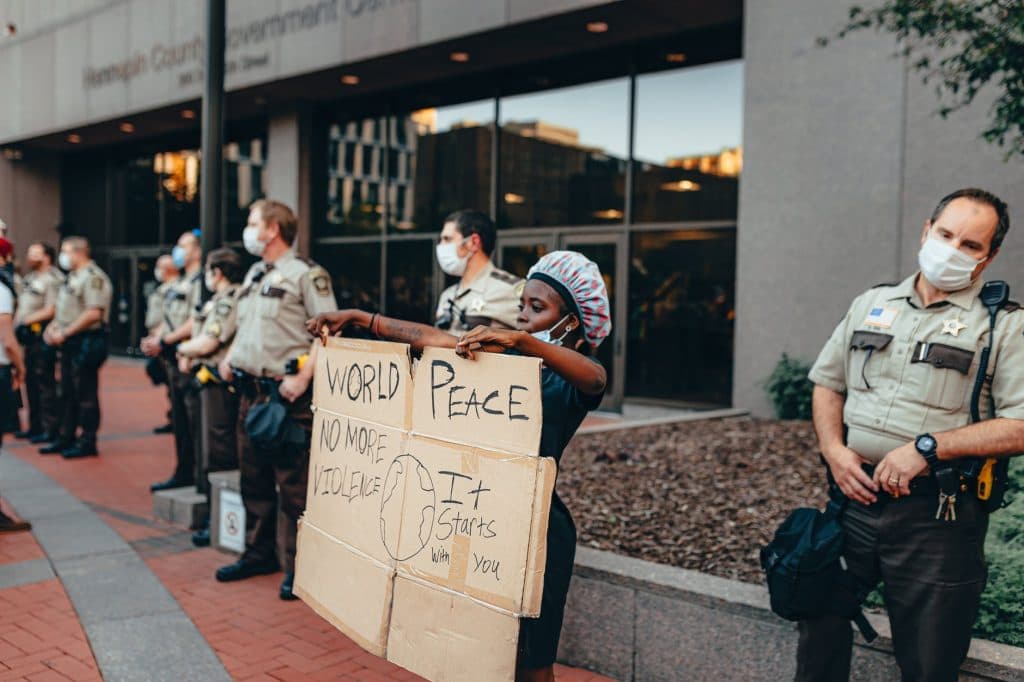
You’re a police officer; you’re clad in full riot gear; you’re on the front line facing a large, noisy protest. The situation is confrontational. The order comes through to break up the demonstration. You are told to advance on the demonstrators, arresting any who resist.
And then you think to yourself, “Actually, I agree with what these demonstrators are protesting about.”
As a police officer or as a member of any law enforcement agency, you are not allowed to have such thoughts. You are not allowed to have such sympathies. You are there to enforce the law – even if you might not agree with it.
A police officer cannot approach their commanding officer to say they are not comfortable doing what they have been asked to do and would rather sit this one out. Whether such an action would be a disciplinary offence, I don’t know; it would certainly not be career-enhancing.
For somebody who works for an enforcement agency – police, army, judiciary – you’re not allowed to have personal principles, beliefs or opinions. They must be left in the locker when you put on the uniform. You are there to follow orders, to do as the law commands. You can no longer be an individual but are part of the government machine. That is what you have signed up for.
You must switch from your own identity to that of a characterless, generic, collective body.
How does that switch work? One minute you can think what you want, the next minute you have to relinquish all your thoughts to do what you are told must be done – even if it goes against what you believe in.
In the UK, I have an enduring image of striking miners in the 1980s being charged by police on horseback. Those mounted officers may well have been from the same communities as the protesting miners. Were they comfortable with what they had to do? When they sat at home after their shift, did they question their actions?
In more authoritarian regimes, such quashing of dissent may be more common and widespread. Members of enforcement agencies may have to be more draconian, more ruthless, more violent. And yet, the line of law and authority seldom weakens or succumbs.
Members of enforcement bodies do not seem to question what they are asked to do. There are countless examples of strong police lines overpowering, even violently suppressing resistance.
- In Russia, protests against the arrest of Alexei Navalny.
- In Hong Kong, there are protests against Chinese rule.
- In Myanmar, the army is shooting at protestors.
When officers make forceful arrests, when they send tear gas into a crowd, when they fire rubber bullets at protestors, what are they thinking?
Do they just think that they’re doing their job? Have they been trained to blindly follow orders? Is their discipline so endemic that they never think to question their actions?
However much training they have received, there must come a point when they realise what they are doing isn’t right.
Perhaps it is a particular focus of the recruitment process that they only appoint candidates who will not challenge authority. Do they search out candidates that don’t mind relinquishing their opinions, candidates that don’t have any opinions, or do they seek candidates who will just follow orders over anything else?
Once recruited, the intensive training means that these people are drilled into obeying orders. There may even be an element of indoctrination in the training. There has to be. It is the only way the system can maintain itself.
Of course, most of the time, these individuals will have no conflicts of interest or dilemmas between their workplace roles and their private lives. Most of the time, their role is to catch those clearly identifiable baddies. That may be the compromise they make – for the sake of occasionally doing something they are not comfortable with, they can have a good, well-paid job and make a contribution to society. It’s a sacrifice they may be prepared to make.
But where does that line between a private life and a public duty sit?
Can an individual who belongs to an enforcement body donate to a political party or to an organisation that acts in the political arena – civil liberties campaigners, nuclear disarmament bodies, environmental pressure groups? Could they join a campaigning organisation like Greenpeace? Would they be allowed to follow behaviours that are contentious, such as being vegetarian?
What would happen if the government proposed to build a major road near where they lived, passing through a bird sanctuary? Could an enforcement officer be a part of any protest movement? How would they respond if, in their working capacity, they had to maintain order at a demonstration? What if that demonstration turned violent? How would they feel about having to arrest their neighbours?
Police officers are not allowed to express any opinion that might be interpreted as unacceptable behaviour while on duty. Yet police officers are allowed to vote.
What happens if their chosen political party loses an election? Might they be less inclined to pursue and enforce the winning party’s policies? The protesters on Capitol Hill were able to make such progress because the enforcement agencies there to guard the building were sympathetic to them.
It seems that to be a member of an enforcement agency may require you to have a particular mindset, may require you to be responsive to a particular form of training, and may require you to appreciate and understand the importance of order and discipline above all else.
Society relies on that thin blue line to maintain order. Despite the pressures placed upon it, it’s surprising how steadfast that line can be.
 Oxthink
Leave a comment