
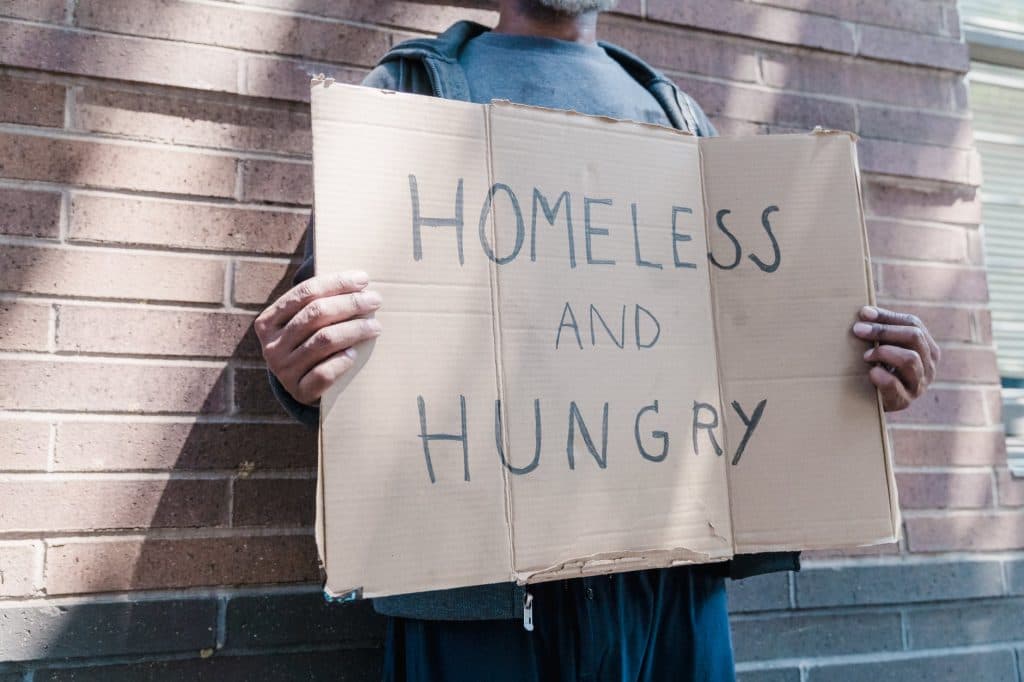
There’s an old adage that says you should not throw good money after bad. Does that apply to people as well?
If there are people who do not contribute anything to society, who demand an insatiable amount of resources, and who show no prospects or ambitions to improve their lives, should we continue to sustain their existence?
What’s the point? They are a burden, and they will always be a burden.
And yet it seems that society is willing to provide support and resources to those in need without expecting much in return. There are jobs to be had in society, but people who would be quite capable of doing those jobs seem to be under no obligation to take them.
They are prepared to take their benefits but are not prepared to give anything back to society. It can seem to be a one-way operation. Society gives; those in need take. What’s fair, what’s right about that?
And the more that’s offered, the more that is taken. Why wouldn’t it be? It’s something for nothing. Of course, they’ll take it.
Giving to the needy, the undeserving, and the unable supposedly shows society’s humanity and appreciation for the value of life. All life is valued; all life should be cherished. It is considered to be a sign of a modern society that the poor, the ill, the disabled, and the unemployed should not be allowed to suffer.
Society looks after its weaker members, offering a safety net for those who need it. And rightly so. People shouldn’t have to endure hardship because of misfortune or difficult circumstances. However, it is apparent that there are far too many who choose to unscrupulously take advantage of society’s benevolence.
Perhaps we need to reconsider society’s generosity to those who are continually unemployed, those who commit crimes against society and those who sponge off society, including those on disability benefits who could still, if they wanted to, make some worthwhile contribution to society.
Benefits should not be taken for granted. They need to be earned; they need to be appreciated. They should be considered a privilege rather than an expected right.
Achieving this is not as straightforward as one might expect.
We have to recognise that society’s generosity isn’t entirely philanthropic. We shouldn’t be fooled. There is an ulterior motive. It is society’s need for self-preservation that requires it to spend resources on the weaker, less productive members of society. It is acting entirely out of self-interest.
This is because society’s main role is to preserve order and stability. It has to find the best way of doing this. Over the centuries, it has learnt that force and compulsion are not all that effective; subjugating and exploiting its population carries too great a risk – uprisings, revolutions, militant action and civil war.
Instead, society has developed an alternative, more inclusive strategy. It seeks to placate the weaker members of society by buying them off. In other words, it pays them to behave themselves.
Without the support that society gives, these discontented, needy people, struggling to survive, could threaten and undermine society. Most notably, by turning to crime. In so doing, they would continually chip away at the foundations of society; a disruptive influence, a blight on its existence. Challenging, troublesome, resistant – they would be like an incurable cancer that has to be kept in check, something that cannot be allowed to spread or grow.
But by giving society’s needy the sense that they benefit from society, that they are part of society, and that, without society, they might lose out, it gives them a stake in the societal organisation, which means they are less likely to cause trouble.
They are onto a good thing. They get something for nothing. Society looks after them. Why would they object to that? Why would they want to jeopardise that? They might lose the cushy number that they are on.
And yet, from society’s point of view, a fine balance has to be struck.
If society gives too much away, too many of its population will be tempted to take advantage of that generosity, and society will struggle to fulfil all its functional responsibilities. Why would people want to work if they can have a good life on benefits?
Furthermore, those who do thrive in society and do pay their taxes to maintain it will begin to take exception to the financial demands made on them. They will become resentful not only of the fact that they are constantly having to give up more of their income, but will also become resentful of those lazy, non-contributing beneficiaries who are in receipt of such largesse.
However, if society is not generous enough, that too may cause problems. Society may begin to feel the rumblings of discontent as those in need become more agitated. There is a chance that such disquiet can lead to societal breakdown – protests, strikes, crime, riots.
The problem with society pursuing this supportive strategy is that it generates a bottomless pit of demand:
- In terms of reach, the number of different groups in society appealing for support will grow. If that group of people are receiving support, then why isn’t this other group?
- The growth of society means that the number of people receiving support will also rise.
- What is offered will never be enough. There will always be a demand for greater support.
Society has to tread a fine line as to what it can get away with. Too much threatens society’s ability to function; too little threatens it with unrest and instability. The trick is to give enough away to quell rebellious discontent but not so much as to undermine society’s ability to operate.
In seeking to preserve harmony and order, besides buying off its nuisance population, society has one other tool in its armoury. If it can increase its population’s commitment and interest in society, this will improve society’s stability and functioning. The key to doing this lies in providing employment and housing. Aside from consideration for their family, these are the two primary stakes individuals have in society.
People will think twice before they risk losing them.
And there’s the great conundrum… we want people in contributory employment and good housing to give them a greater stake in society, and yet by paying them benefits, we deter them from achieving it. We are effectively telling them that they don’t have to work.
There is no incentive for them to become more engaged with society.
Perhaps we might therefore be throwing our money in the wrong direction.
 Oxthink
Leave a comment